 ▶59:31
This interface is currently displayed in English. Full translation is in preparation.
Understanding Hateful Extremism in the UK
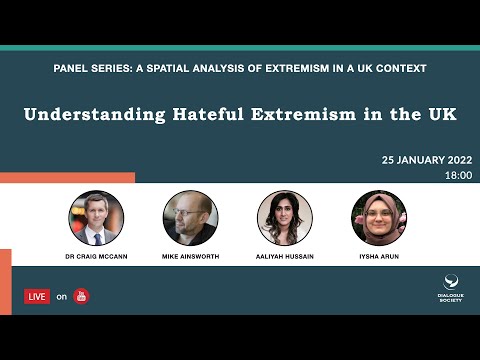
Dialogue SocietySPEAKERS: ● Dr Craig McCann, Centre for Analysis of the Radical Right ● Mike Ainsworth, Chair of the Independent Advisory Group on Hate Crime to the National Police Chiefs Council ● Aaliyah Hussain, Director and Founder, WeRise UK ● Iysha Arun, Research Fellow, Dialogue Society A 2019 independent report presented by the Commission on Extremism titled “Challenging Hateful Extremism” adds a further possible dimension to the traditional understanding of extremism within governmental discussions and policy development. Defined as, “behaviours that can incite and amplify hate, or engage in persisteRead moreShow less
SPEAKERS:
● Dr Craig McCann, Centre for Analysis of the Radical Right
● Mike Ainsworth, Chair of the Independent Advisory Group on Hate Crime to the National Police Chiefs Council
● Aaliyah Hussain, Director and Founder, WeRise UK
● Iysha Arun, Research Fellow, Dialogue Society
A 2019 independent report presented by the Commission on Extremism titled “Challenging Hateful Extremism” adds a further possible dimension to the traditional understanding of extremism within governmental discussions and policy development.
Defined as, “behaviours that can incite and amplify hate, or engage in persistent hatred, or equivocate about and make the moral case for violence. And that draw on hateful, hostile or supremacist beliefs directed at an out-group who are perceived as a threat to the wellbeing, survival or success of an In-group. And that cause, or are likely to cause, harm to individuals, communities or wider society.”, hateful extremism poses a threat to cohesion within our communities and the safety of our society as a whole.
Our panel aims to elaborate on the term hateful extremism with the hope of ensuring, firstly a better understanding of what it constitutes and then how an understanding can aid in challenging hateful extremism.
● What is “Hateful Extremism”?
● What are the pros’ and cons’ of defining the term “Hateful Extremism”? How beneficial is this definition for us?
● What are the different ways in which hateful extremism can be manifested?
● What role does social media play in the dissemination of hateful extremism?
● Who are the groups most vulnerable to this form of extremism, and what can be done to challenge them?
Subscribe ►http://bit.ly/SubsDialogueSociety
Donate ► https://www.paypal.me/DialogueSociety
Become a patron ► https://www.patreon.com/DialogueSociety
Visit us ►http://www.dialoguesociety.org
Sign up for our newsletter ►http://eepurl.com/du5E6X
Twitter ►https://twitter.com/DialogueSociety/
Instagram ►https://www.instagram.com/dialoguesociety/
Facebook ►https://www.facebook.com/DialogueSociety
About Dialogue Society
The Dialogue Society is a registered charity (Registered Charity Number: 1117039), established in London in 1999, with the aim of advancing social cohesion by connecting communities, empowering people to engage and contributing to the development of ideas on dialogue and community building. The Dialogue Society is not a religious or ethnic organisation. It aims to facilitate dialogue on a whole range of social issues, regardless of any particular faith or religion. It stands for democracy, human rights, the non-instrumentalisation of religion in politics, equality, and freedom of speech.