 ▶59:31
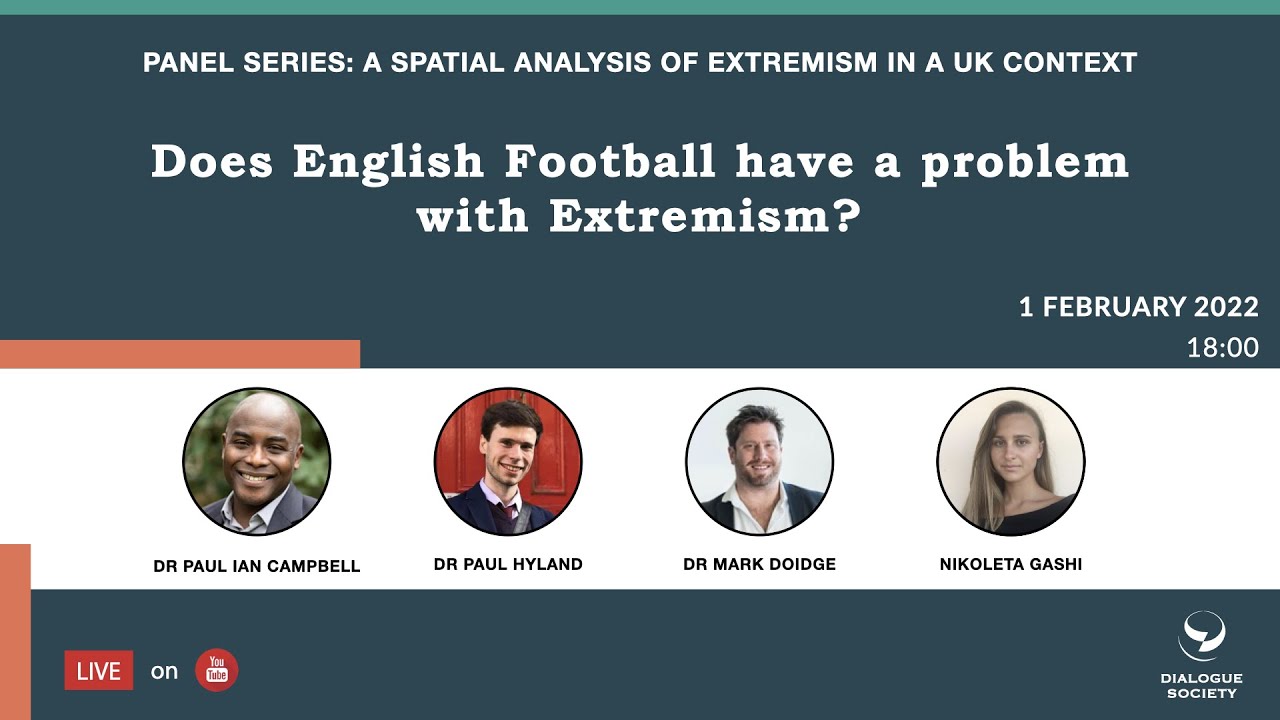
Does English Football have a problem with Extremism?
Dialogue SocietySPEAKERS ◉ Dr Paul Ian Campbell, Sociology Lecturer and Chair of the University of Leicester Race Equality Action Group ◉ Dr Paul Hyland, Football Writer, PhD- University of Cambridge ◉ Dr Mark Doidge, Principal Research Fellow at the University of Brighton, School of Sport and Health Sciences ◉ Nikoleta Gashi, Research Fellow and Project Coordinator, Dialogue Society ABSTRACT Historically, football has been an arena for rivalries to play out. Charged, alcohol-fuelled and with a predominantly male following, football games, at both a club and national level, have been fertile ground for socialRead moreShow less
SPEAKERS
◉ Dr Paul Ian Campbell, Sociology Lecturer and Chair of the University of Leicester Race Equality Action Group
◉ Dr Paul Hyland, Football Writer, PhD- University of Cambridge
◉ Dr Mark Doidge, Principal Research Fellow at the University of Brighton, School of Sport and Health Sciences
◉ Nikoleta Gashi, Research Fellow and Project Coordinator, Dialogue Society
ABSTRACT
Historically, football has been an arena for rivalries to play out. Charged, alcohol-fuelled and with a predominantly male following, football games, at both a club and national level, have been fertile ground for social divisions as well as social bonds. The latest survey conducted by YouGov in 2021, revealed that sixty two percent of match-attending fans feared a player would be racially abused at a game and a further seventy-three per cent of ethnically diverse fans were concerned about racial abuse in stadiums. Social media platforms, as anonymity-awarding spaces are also facilitating the spread of hatred online, as seen after England’s loss in the Euro 2020 final when three black-British players were subjected to abhorrent abuse on Twitter and Instagram.
But, in an age where football is the most diverse it has ever been, where some of the best English footballing talents are of mixed ethnicity and when there is a multicultural trend in club and international European football, why is it that xenophobia, anti-Semitism, hooliganism and Islamophobia continue to prevail?
Should acts of xenophobia, hooliganism, anti-Semitism and Islamophobia be considered forms of extremism and if so, should we move away from security-oriented notions of the term?
Why do these behaviours emerge in football? What is it about the footballing ‘space’ or the sport that means these behaviours take place?
What is the psychology behind fanatic behaviour that turns abusive or extreme?
What can be done to combat or curtail these acts?
Can we use the game as a reaction to these acts? If so, what role can football play in understanding and combatting hate crime and extremist activity?
This panel will seek to illuminate the recent issues regarding racist abuse in football which emerged in public discourse as a result of Euro 2020, including examining English Football’s long history of hooliganism. It will also seek to answer whether the current notion of extremism ought to be expanded to account for other forms of hatred and abuse that prevail in the space of football.
Subscribe ►http://bit.ly/SubsDialogueSociety
Donate ► https://www.paypal.me/DialogueSociety
Become a patron ► https://www.patreon.com/DialogueSociety
Visit us ►http://www.dialoguesociety.org
Sign up for our newsletter ►http://eepurl.com/du5E6X
Twitter ►https://twitter.com/DialogueSociety/
Instagram ►https://www.instagram.com/dialoguesociety/
Facebook ►https://www.facebook.com/DialogueSociety
About Dialogue Society
The Dialogue Society is a registered charity (Registered Charity Number: 1117039), established in London in 1999, with the aim of advancing social cohesion by connecting communities, empowering people to engage and contributing to the development of ideas on dialogue and community building. The Dialogue Society is not a religious or ethnic organisation. It aims to facilitate dialogue on a whole range of social issues, regardless of any particular faith or religion. It stands for democracy, human rights, the non-instrumentalisation of religion in politics, equality, and freedom of speech.