 ▶4:23
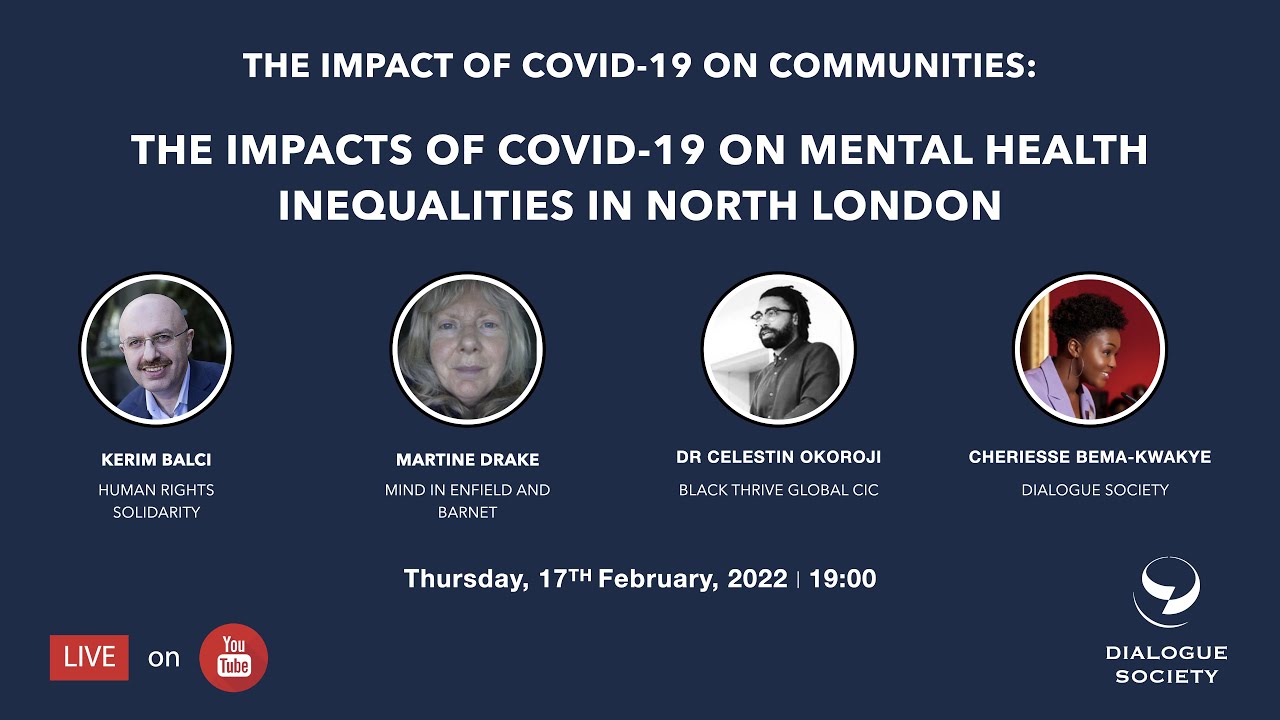
The Impacts of COVID-19 on Mental Health Inequalities in North London
Dialogue Society◎ Speakers ● Kerim Balci, Chief Advisor, Human Rights Solidarity; Founder, OnlineHizmet ● Martine Drake, Wellbeing, Learning and Activities Manager, MIND in Enfield and Barnet ● Dr Celestin Okoroji, Postdoctoral Fellow, LSE; and Research Lead, Black Thrive Global CIC ● Cheriesse Bema-Kwakye, Research Fellow and Project Co-ordinator, Dialogue Society ◎ Abstract The pandemic has induced a considerable degree of fear, worry and concern across the population at large, and among certain groups in particular, such as the youth, the elderly, key workers, and people with underlying health conditions. Read moreShow less
◎ Speakers
● Kerim Balci, Chief Advisor, Human Rights Solidarity; Founder, OnlineHizmet
● Martine Drake, Wellbeing, Learning and Activities Manager, MIND in Enfield and Barnet
● Dr Celestin Okoroji, Postdoctoral Fellow, LSE; and Research Lead, Black Thrive Global CIC
● Cheriesse Bema-Kwakye, Research Fellow and Project Co-ordinator, Dialogue Society
◎ Abstract
The pandemic has induced a considerable degree of fear, worry and concern across the population at large, and among certain groups in particular, such as the youth, the elderly, key workers, and people with underlying health conditions. British Medical Journal reported that 'increased psychological morbidity was evident in the UK sample and found to be more common in younger people, women and in individuals who had been identified as part of the 'COVID-19 risk groups'. Mental Health Foundation reported that across the UK population 8% of adults surveyed in April 2020 said they had thoughts and feelings about suicide in the previous two weeks. However, this has risen to 13% in February 2021.
Currently, however, the UK is faced with a mixed picture. According to Mental Health Foundation's latest research, the UK population is much more hopeful now than they had been since the first lockdown with 30% feeling more hopeful in February 2021 compared to only 14% in March 2020. However, feelings of loneliness have not returned to their pre-lockdown levels at any point over the past year and have risen from 10% in March 2020 to 26% in February 2021.
Feelings of hopelessness and loneliness have been especially high among young people who have also experienced higher levels of stress and anxiety due to pressures of online school and concern for the future. The January 2021 YoungMinds survey found that 75% of participants found the last lockdown more difficult to cope with and 67% believed that the pandemic will have a long-term impact on their mental health.
Local councils and mental health charities have worked hard to tackle the increased demand for their services. More 24-hour available helplines were set up and e-consults were made available. As we are emerging from the brunt of the pandemic, it is important that we assess its long-term impact on people's mental health and discuss measures to support those in need of assistance. In our forward-thinking panel, our discussion will look at the pandemic's impact on mental health and how local communities, like those in North London, responded to the rising need of support, as well as a dialogue on how best to reconstruct our society to prevent a socially debilitating mental health epidemic.
Subscribe ►http://bit.ly/SubsDialogueSociety
Donate ► https://www.paypal.me/DialogueSociety
Become a patron ► https://www.patreon.com/DialogueSociety
Visit us ►http://www.dialoguesociety.org
Sign up for our newsletter ►http://eepurl.com/du5E6X
Twitter ►https://twitter.com/DialogueSociety/
Instagram ►https://www.instagram.com/dialoguesociety/
Facebook ►https://www.facebook.com/DialogueSociety
About Dialogue Society
The Dialogue Society is a registered charity (Registered Charity Number: 1117039), established in London in 1999, with the aim of advancing social cohesion by connecting communities, empowering people to engage and contributing to the development of ideas on dialogue and community building. The Dialogue Society is not a religious or ethnic organisation. It aims to facilitate dialogue on a whole range of social issues, regardless of any particular faith or religion. It stands for democracy, human rights, the non-instrumentalisation of religion in politics, equality, and freedom of speech.