 ▶59:31
Dialogue and Environmental Education | Rafael Monteiro
Dialogue SocietyRafael Monteiro presented his paper, co-authored with Marcos Sorrentino, "Dialogue and Environmental Education: Conflicts between Marine Conservation and Fishing" in the second session (Dialogue, Conflict Resolution and Peacebuilding) of the Critical Dialogues: Dialogue and Conflict Resolution workshop, which was organised in partnership with Dialogue Society and the Journal of Dialogue Studies on 28 Nov 2019, London. ► Abstract: This research sought to analyse how the environmental educator process developed by a non- governmental organisation with maritime artisanal fishermen from the coast Read moreShow less
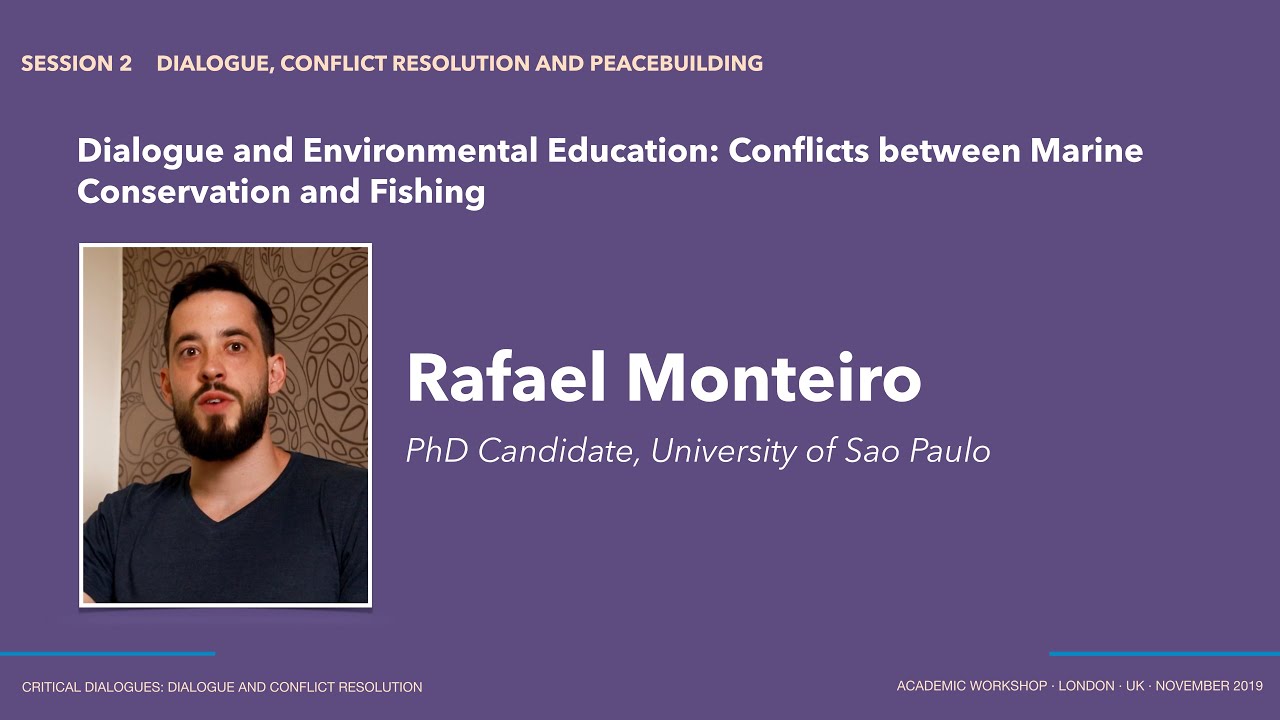
Rafael Monteiro presented his paper, co-authored with Marcos Sorrentino, "Dialogue and Environmental Education: Conflicts between Marine Conservation and Fishing" in the second session (Dialogue, Conflict Resolution and Peacebuilding) of the Critical Dialogues: Dialogue and Conflict Resolution workshop, which was organised in partnership with Dialogue Society and the Journal of Dialogue Studies on 28 Nov 2019, London.
► Abstract:
This research sought to analyse how the environmental educator process developed by a non- governmental organisation with maritime artisanal fishermen from the coast of São Paulo (Brazil) helped to foster dialogue to face the conflict of marine conservation versus fisheries. The data were collected through the analysis of documents and semi-structured interviews composed of a set of indicator questions divided into three categories: external aspects, internal aspects, and dialogical action and answers analysed using a synthesis of the ideas on dialogue of Martin Buber, David Bohm, William Isaacs and Paulo Freire. The results show the incipience of dialogue in the relationship between the actors. The external dialogical aspects were limited to the weekly frequency of the conversations and some formations of the participants in certain meetings. The internal aspects revealed the establishment of two types of relations: one anti-dialogical and another that we called incipient dialogical. In relation to the dialogical action, it was possible to verify the beginning of a process according to the principles of the culture circles, which did not have continuity. Regarding the pedagogical strategies adopted in the different environmental education meetings, it is possible to affirm that the one used in the participatory diagnoses was the only one that potentiates the emergence of dialogue. Finally, it was possible to find dialogical potentialities, which should be stimulated together with the creation of new ones, in order to allow the effective transition to a new model of fishing and society.
► About Rafael de Araujo Arosa Monteiro
Rafael de Araujo Arosa Monteiro is a PhD student and MSc in Environmental Science (2018) from the University of São Paulo; specialist in Environmental Education for Sustainability from University Center Senac (2015); and Bachelor of Environmental Management from the University of São Paulo (2012). He has experience in the environmental education process developed by Brazilian NGOs of marine conservation. He is a researcher in the Laboratory of Environmental Education and Policy (Oca) at the University of São Paulo, where he investigates the dialogue in processes of environmental education, seeking to develop dialogical methods and indicators.
► Academic Workshop: Critical Dialogues: Dialogue and Conflict Resolution
Dialogue Society and the Journal of Dialogue Studies organised a workshop on Nov 28, 2019 in London addressing the topic of ‘Critical Dialogues: Dialogue and Conflict Resolution’. As a tool of conflict resolution, dialogue can take on many different shapes and can be moulded to respond to each conflict. In some cases, it becomes a tent that gives shelter to both sides, creating an environment of peace and security; in some other cases, it becomes a ship that saves the parties from the results of the conflict. In all these shapes and forms, dialogue constructs an aura facilitating parties to settle their incompatible differences.
In this workshop we had 15 papers critically addressing the role of dialogue/s in resolution of different types/forms of conflicts, from military to inner (psychological and psychosocial) conflicts of individuals. The workshop highlighted four themes related to the concept of dialogue. These are:
► Intercultural Dialogue and Conflict
► Dialogue, Conflict Resolution and Peacebuilding
► Dialogue, Conflict and Education
► Dialogue and Conflict in a Changing World
Subscribe ►http://bit.ly/SubsDialogueSociety
Donate ► https://www.paypal.me/DialogueSociety
Becoma a patron ► https://www.patreon.com/DialogueSociety
Visit us ►http://www.dialoguesociety.org
Sign up to our newsletter ►http://eepurl.com/du5E6X
Twitter ►https://twitter.com/DialogueSociety/
Instagram ►https://www.instagram.com/dialoguesociety/
Facebook ►https://www.facebook.com/DialogueSociety
About Dialogue Society
The Dialogue Society is a registered charity (Registered Charity Number: 1117039), established in London in 1999, with the aim of advancing social cohesion by connecting communities, empowering people to engage and contributing to the development of ideas on dialogue and community building. The Dialogue Society is not a religious or ethnic organisation. It aims to facilitate dialogue on a whole range of social issues, regardless of any particular faith or religion. It stands for democracy, human rights, the non-instrumentalisation of religion in politics, equality, and freedom of speech.