 ▶4:23
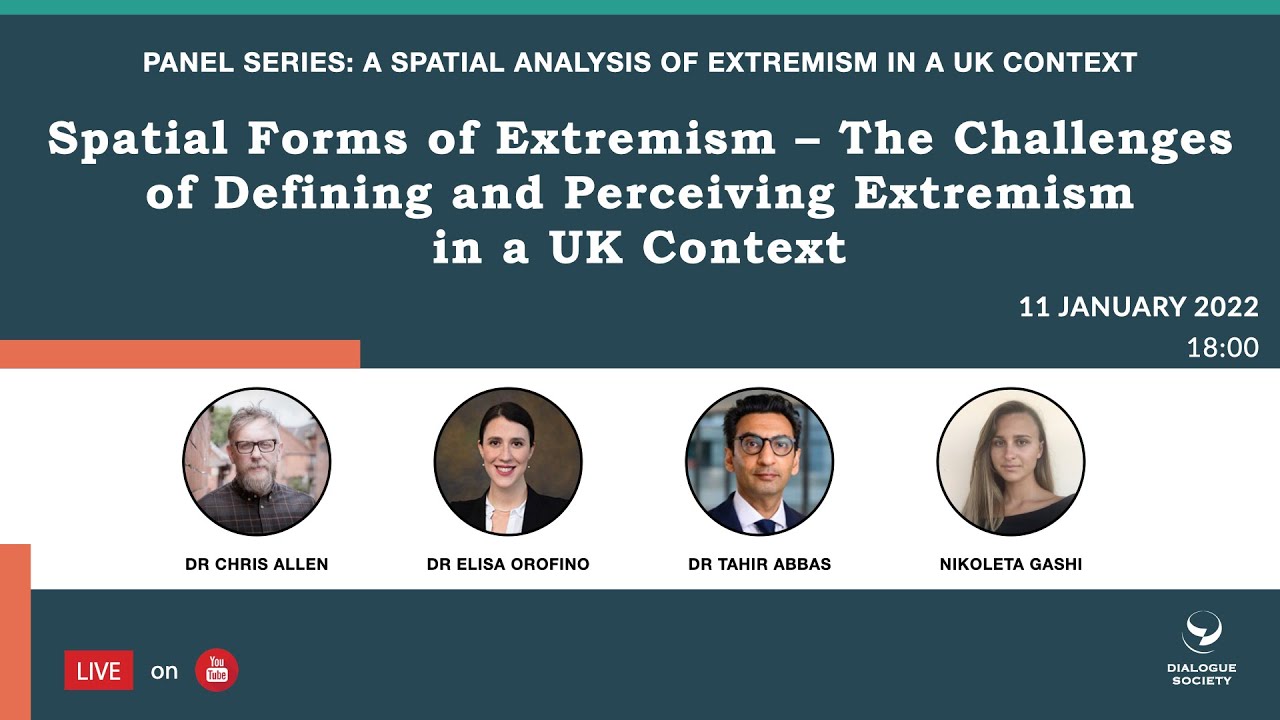
Spatial Forms of Extremism – The Challenges of Defining and Perceiving Extremism in a UK Context
Dialogue SocietySPEAKERS: ● Dr Chris Allen, Associate Professor in Hate Studies at the Centre for Hate Studies, Department of Criminology, at the University of Leicester ● Dr Elisa Orofino, Research Lead on Extremism and Counter-Terrorism at the Policing Institute for the Eastern Region (PIER), Anglia Ruskin University ● Dr Tahir Abbas, Associate Professor in Terrorism and Political Violence at the Institute of Security and Global Affairs at Leiden University, Netherlands ● Nikoleta Gashi, Research Fellow and Project Coordinator, Dialogue Society “Extremist” was first popularised in eighteenth century AmericaRead moreShow less
SPEAKERS:
● Dr Chris Allen, Associate Professor in Hate Studies at the Centre for Hate Studies, Department of Criminology, at the University of Leicester
● Dr Elisa Orofino, Research Lead on Extremism and Counter-Terrorism at the Policing Institute for the Eastern Region (PIER), Anglia Ruskin University
● Dr Tahir Abbas, Associate Professor in Terrorism and Political Violence at the Institute of Security and Global Affairs at Leiden University, Netherlands
● Nikoleta Gashi, Research Fellow and Project Coordinator, Dialogue Society
“Extremist” was first popularised in eighteenth century America by Daniel Webster, to reference slavery’s most passionate defenders. Since then, the term has spread and evolved beyond its original context. Although there is no legal definition for extremism in the UK, in 2015, the UK Government defined the term in their ‘Counter Extremism’ policy strategy as: “vocal or active opposition to fundamental British values, including democracy, the rule of law, individual liberties, mutual respect and tolerance of different faiths and beliefs.” Also included in the definition, is calls for the death of members of the armed forces, either in the UK or overseas. Today, “extremism” as a term has become a polarising debate for policy makers, academics and legal professionals who have struggled to define it and have criticised it for several reasons, from its nebulous meaning which has made it open to interpretation and stereotyping, to its special emphasis on the armed forces over other contexts where extremism could prevail. Meanwhile, some experts are calling for a revision of policy interventions which seem to have been created along religious lines.
This is not the first time the Dialogue Society convenes to discuss extremism. In recent years, we have dialogued about Violent Extremism and Hateful Extremism and the threat these issues pose to the social cohesion of communities and the safety of all members of society. So, what are the key problems surrounding defining ‘extremism’ across academia, policy and legislation in 2021?
● So, what are the key challenges surrounding defining ‘extremism’ across academia, policy and legislation in 2021?
● What is extremism and how does it prevail in certain spaces of society? Why does extremism surface in some spaces and not others? How does it differ from radicalisation and terrorism?
● How has extremism been perceived in mainstream media which may be affecting our understandings of the term?
● Is the current definition of extremism at risk of inciting extremist behaviours among individuals? How do extremists harness the media to spread their rhetoric and ideologies?
● What are the main policies in the UK towards countering extremism?
● Have these policies been effective in dealing with the threat of extremism?
Subscribe ►http://bit.ly/SubsDialogueSociety
Donate ► https://www.paypal.me/DialogueSociety
Become a patron ► https://www.patreon.com/DialogueSociety
Visit us ►http://www.dialoguesociety.org
Sign up for our newsletter ►http://eepurl.com/du5E6X
Twitter ►https://twitter.com/DialogueSociety/
Instagram ►https://www.instagram.com/dialoguesociety/
Facebook ►https://www.facebook.com/DialogueSociety
About Dialogue Society
The Dialogue Society is a registered charity (Registered Charity Number: 1117039), established in London in 1999, with the aim of advancing social cohesion by connecting communities, empowering people to engage and contributing to the development of ideas on dialogue and community building. The Dialogue Society is not a religious or ethnic organisation. It aims to facilitate dialogue on a whole range of social issues, regardless of any particular faith or religion. It stands for democracy, human rights, the non-instrumentalisation of religion in politics, equality, and freedom of speech.